
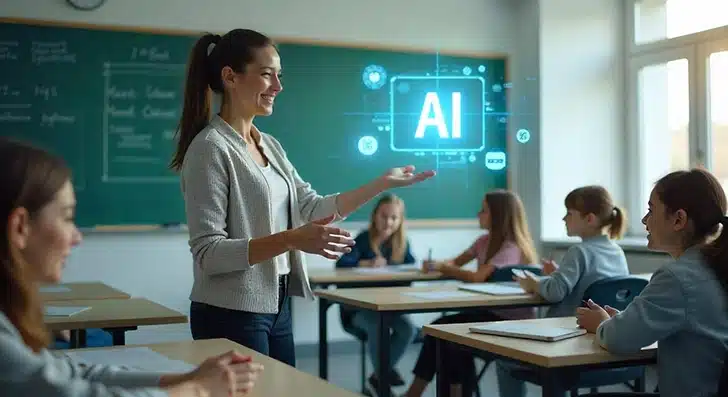
Smart Support
1. The Partnership Model
We do not replace school teachers; they act as “Enablement Partners.”
- Curriculum Design: We provide age-appropriate syllabi (like AI for Classes 1–10) that align with national frameworks like the NEP 2020 in India.
- Teacher Empowerment: Since training one crore (10 million) teachers is a massive hurdle, institutes use “Train the Trainer” (TTT) models. They provide teachers with lesson plans, AI-powered grading tools, and “AI Copilots” to help manage classrooms.
- Infrastructure Support: If any Institute dont have Computer Lab,we set up “AI Labs” o& We also provide cloud-based platforms (like Google Colab or Vertex AI) so students can run complex models without needing expensive local hardware.
2. Age-Appropriate Curriculum (Class 1-10)
The training is typically broken down into developmental stages:
| Level | Focus Area | Example Activities |
| Foundational (Class 3-5) | AI Literacy | Games that teach how data sorting works; “AI for Oceans” projects to classify trash vs. sea life. |
| Middle (Class 6-8) | Applied AI | Building simple chatbots; using “Unplugged” activities (logic puzzles) to understand algorithms without a screen. |
| Secondary (Class 9-12) | Technical Skills | Learning Python, Natural Language Processing (NLP), and ethical debates on AI bias and privacy. |
3. How the “Training” Actually Happens
- Project-Based Learning (PBL): Students don’t just read about AI; they build things. For example, a student might create an AI storybook where the AI helps co-write the plot or generate illustrations.
- Gamification: Many institutes use platforms like “AI Arcade” where students complete “missions” (e.g., “Design a sustainable city using AI data modeling”) to earn badges.
- Real-World Integration: AI is often linked to “The World Around Us” (TWAU). A geography lesson might use AI to simulate climate change impacts, making the technology a tool for other subjects rather than a standalone topic.
4. Key Benefits for the School
Future Readiness: By the time a current 3rd grader graduates (around 2035), AI fluency will be a basic job requirement. These institutes ensure students are “AI-native” rather than just passive users.
Personalized Learning: AI tools analyze student performance in real-time. If 40% of a class misses a specific math concept, the AI alerts the teacher immediately to re-teach that specific area.
Administrative Relief: AI handles attendance, automated grading for objective tests, and even generates personalized feedback for students, giving teachers 20-40% more time to focus on mentorship.
About Us
At Prigag Schools, we empower educators and students with AI-driven tools that make learning personalized, simple, and effective.


Get Started
Bring AI-powered learning to your school today with prigag schools.